DinoFrontier
About Velociraptor
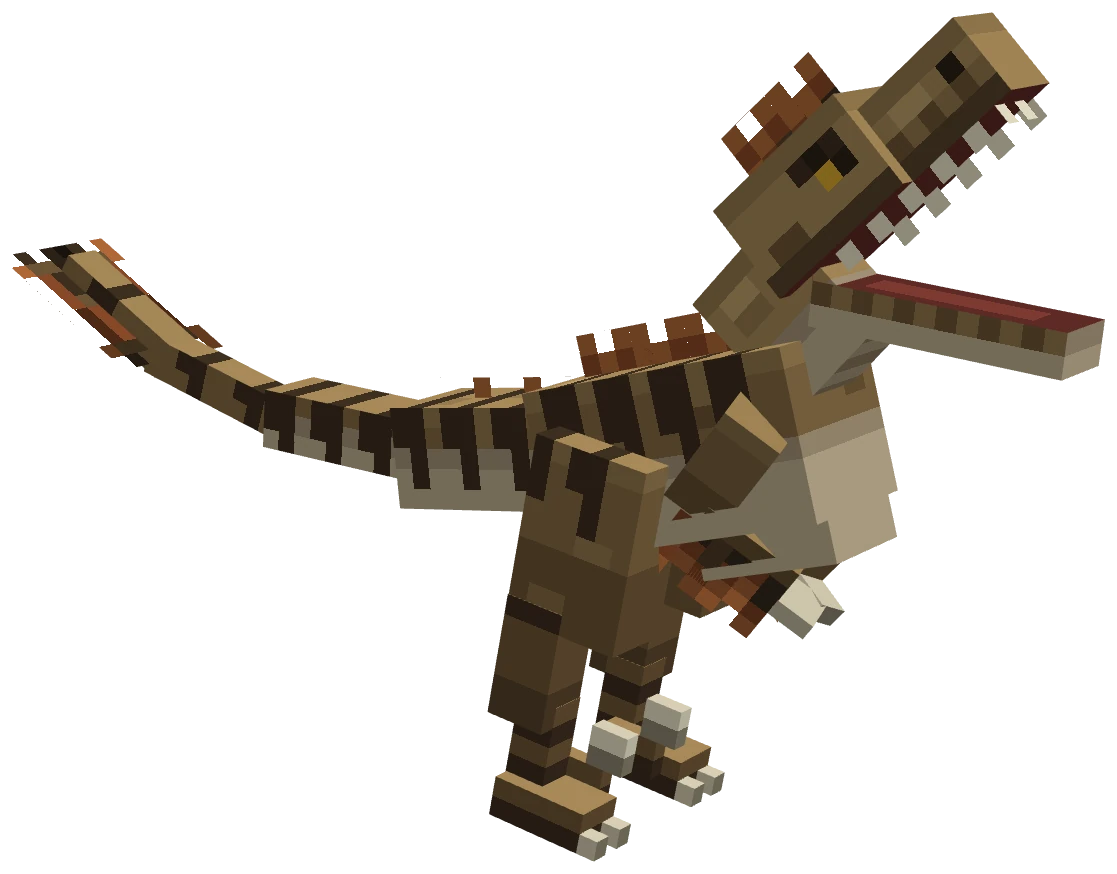
The real Velociraptor was far smaller than the film version: about the size of a turkey, standing roughly half a metre tall at the hip. It lived in a dry, dune-filled landscape in what is now the Gobi Desert of Mongolia, around 75 to 71 million years ago.
Its long, low skull held around 26–28 serrated teeth on each side of the upper jaw, and the second toe of each foot carried an enlarged, sickle-shaped claw about 6.5 cm long that was held off the ground while walking. A stiffened tail helped it balance and turn.
Velociraptor was feathered. A forearm bone described in 2007 shows quill knobs, the bumps where large wing feathers anchor in modern birds, even though it could not fly.
Velociraptor facts
- The "Fighting Dinosaurs" fossil, found in 1971, preserves a Velociraptor locked in combat with a Protoceratops, its sickle claw in the herbivore's neck while its arm is caught in the Protoceratops' beak.
- The "raptors" of Jurassic Park were modelled on the much larger Deinonychus and were given the name Velociraptor because it sounded more dramatic.
- A Velociraptor specimen has been found with a pterosaur bone in its gut, showing it would scavenge or eat whatever it could catch.
- The sickle claw was probably used to pin down and hold struggling prey, much like modern hawks and eagles do with their talons.
Discovery
Peter Kaisen found the first skull and a claw at the Flaming Cliffs in 1923 during the American Museum of Natural History's Central Asiatic Expeditions. Osborn named it the following year. Later Polish-Mongolian and American-Mongolian expeditions recovered many more specimens.