DinoFrontier
About Sarcosuchus
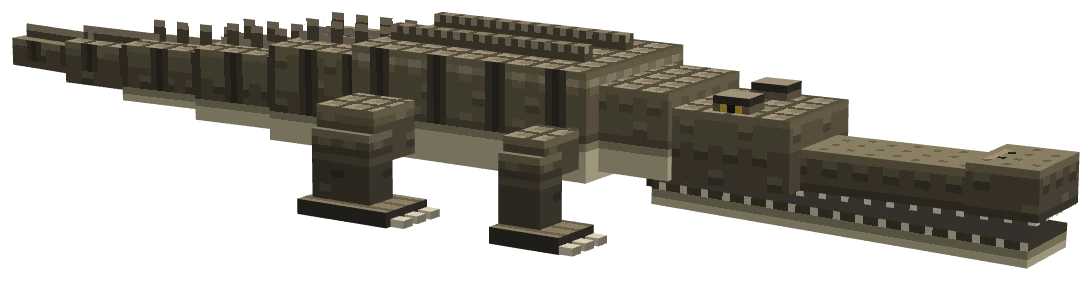
Sarcosuchus, nicknamed "SuperCroc", was one of the largest crocodile-like reptiles ever. It lived about 112 million years ago in the great river systems of what is now the Sahara, when the region was lush and wet.
Its long snout made up about 75% of its skull length, and ended in a large bony bulb called a bulla, whose purpose is still unknown. Its jaws held well over 100 teeth, and its back was covered in heavy bony plates called osteoderms.
It was not a direct ancestor of modern crocodiles but a member of an extinct side branch. Like today's crocodiles it was probably an ambush hunter, lying in wait in the water.
Sarcosuchus facts
- Growth rings in its osteoderms suggest it took 50–60 years to reach full size, growing throughout its life.
- A full-grown Sarcosuchus skull is about 1.6 m long.
- It shared its rivers with the giant fish-eating dinosaur Suchomimus and the long-necked sauropod Nigersaurus.
- The bulla at the tip of its snout may have helped with making sounds, smell or display.
Discovery
French palaeontologist Albert-Félix de Lapparent's expeditions to the Sahara in the 1940s and 50s found its first remains. France de Broin and Philippe Taquet named it in 1966. Paul Sereno's team found far more complete fossils in Niger in 1997 and 2000, which made "SuperCroc" famous.