DinoFrontier
About Tyrannosaurus
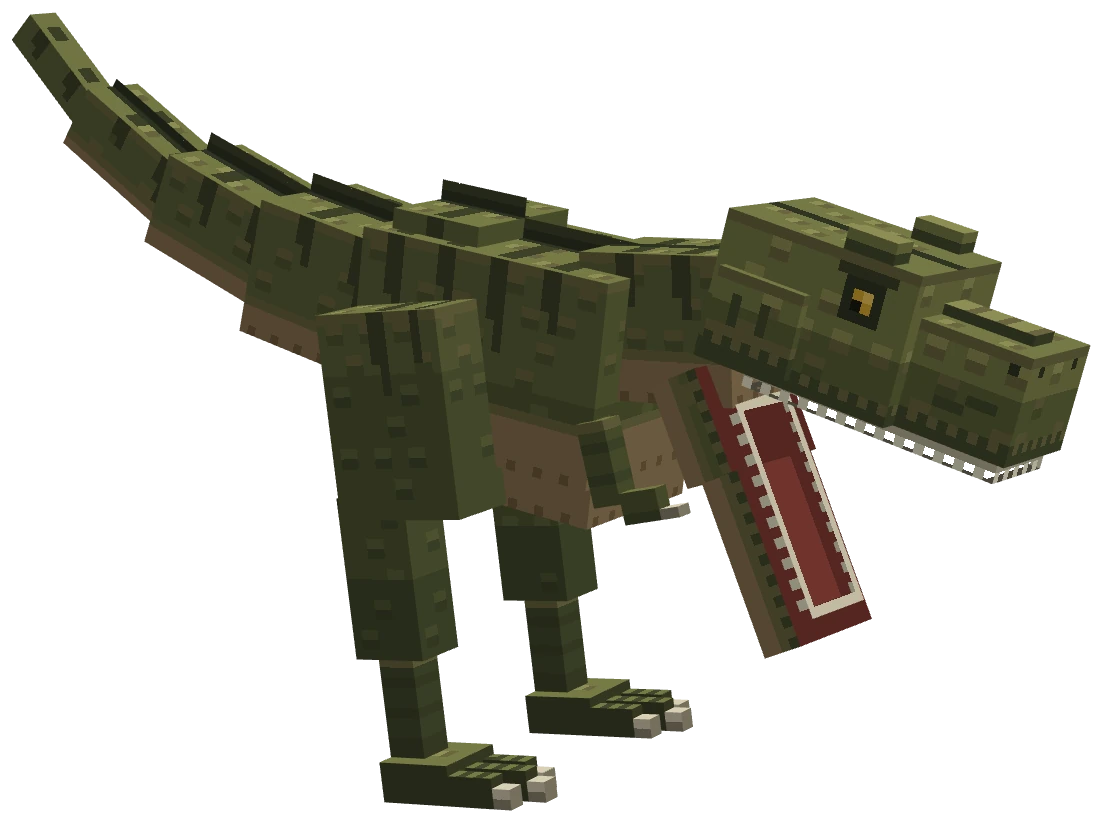
Tyrannosaurus rex was one of the last non-avian dinosaurs and one of the largest land predators that has ever lived. It walked the floodplains and forests of western North America during the final two million years of the Cretaceous, alongside Triceratops, Edmontosaurus and Ankylosaurus, until the asteroid impact 66 million years ago ended the age of dinosaurs.
Its skull could be around 1.5 m long, set with banana-sized serrated teeth (the largest, root included, are about 30 cm long). Forward-facing eyes gave it good depth perception, and the large olfactory bulbs in its brain suggest an excellent sense of smell. The famously small arms, only about a metre long, were still strongly muscled.
Growth-ring studies of its bones show that T. rex grew remarkably fast as a teenager, packing on hundreds of kilograms a year, and that even the biggest known individuals died before about 30 years old.
Tyrannosaurus facts
- Bite-force estimates run from about 35,000 to over 57,000 newtons at the back teeth, the strongest of any known land animal.
- Its bite punctured and crushed bone: fossil Triceratops and Edmontosaurus bones carry T. rex tooth marks, and its coprolites (fossil dung) contain bone fragments.
- "Sue" (FMNH PR 2081), one of the largest and most complete specimens, was found in South Dakota in 1990 and is about 90% complete.
- Despite the movies, an adult T. rex was probably not a fast runner. Biomechanical studies put its top speed at roughly 20 km/h or less.
- Its closest living relatives are birds, and close relatives such as Yutyrannus are known to have had feathers.
Discovery
Barnum Brown, collecting for the American Museum of Natural History, found the first partial skeleton in the Hell Creek Formation of Montana in 1902. Henry Fairfield Osborn named it Tyrannosaurus rex in 1905. Today more than 30 specimens are known, making it one of the best-studied large dinosaurs.